Living room design has evolved far beyond aesthetics. Today, architects are increasingly focused on how spaces perform over time – how they handle heat, noise, structural load, and long-term durability. This shift has brought material selection into sharp focus, especially for internal wall systems.
One of the most significant developments in modern construction is the adoption of Autoclaved Aerated Concrete (AAC) block systems. Among these, BirlaNuAerocon AAC Blocks are emerging as a preferred choice for residential and commercial projects due to their balance of strength, insulation, and construction efficiency.
What makes AAC wall systems different?
Traditional brick masonry has been widely used for decades, but it comes with limitations such as higher dead load, slower construction, inconsistent thermal performance, etc.
AAC blocks, on the other hand, are precast, lightweight masonry units made from cement, lime, fly ash, water, and an aeration process. This creates a cellular structure filled with tiny air pockets, which significantly improves performance characteristics.
BirlaNu Aerocon AAC Blocks are designed for faster construction, structural efficiency, and energy performance, making them suitable for modern building requirements.
Why architects are shifting toward AAC wall systems
1. Reduced structural load and smarter design efficiency: One of the biggest advantages of AAC blocks is their lightweight nature. Compared to conventional bricks, AAC blocks significantly reduce dead load on the structure. This allows architects and structural engineers to optimise foundation design and improve overall cost efficiency.
BirlaNu Aerocon AAC Blocks are engineered to be lightweight while maintaining sufficient strength for both load-bearing and non-load-bearing applications.
2. Thermal comfort for modern living rooms: Living rooms are often the most exposed spaces in a home, receiving direct heat from external walls and sunlight. AAC wall systems naturally offer better thermal insulation due to their air-void structure.
This helps in maintaining more stable indoor temperatures, reducing dependency on cooling systems and improving everyday comfort – an increasingly important factor in energy-conscious design.
3. Acoustic performance for urban homes: With urban housing becoming denser, noise control has become a priority in residential design. AAC blocks offer superior sound insulation compared to traditional masonry due to their porous structure.
This makes them particularly useful for living rooms facing busy streets, apartment clusters, or mixed-use developments where acoustic comfort is essential.
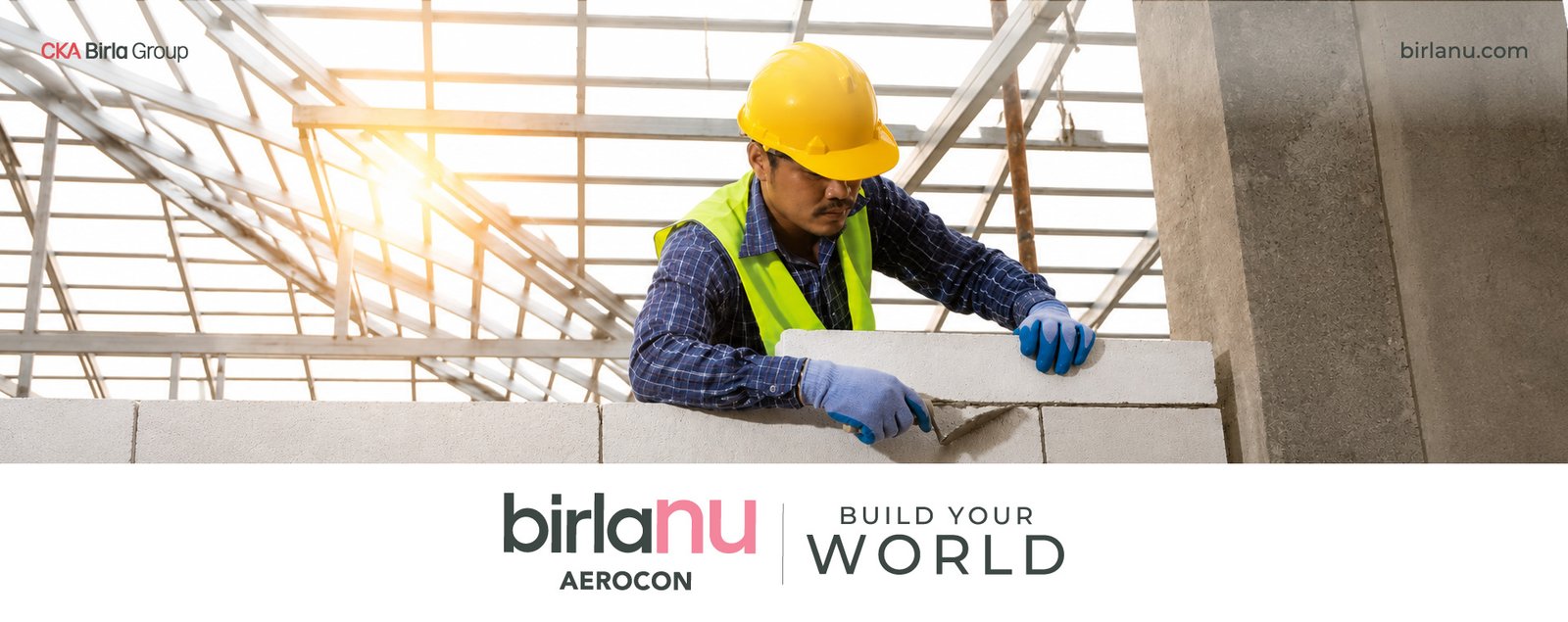
4. Faster construction and design flexibility: Speed of execution is another key reason architects prefer AAC systems. Because of their larger size and uniformity, AAC blocks reduce construction time significantly compared to conventional bricks.
BirlaNu Aerocon AAC Blocks are designed for precision and dimensional accuracy, enabling smoother installation and thinner mortar joints. This also improves finish quality and reduces plaster requirements.
BirlaNu Aerocon AAC Block range for modern construction
BirlaNu offers a complete AAC walling ecosystem under the Aerocon brand, designed for different structural and performance needs.
1. BirlaNu Aerocon AAC Blocks
These are the core walling units used for general construction. They are lightweight, thermally efficient, and suitable for residential, commercial, institutional, and industrial applications.
They are commonly used for:
- Internal partition walls
- External walls
- Residential and commercial structures
- Load-bearing and non-load-bearing walls
2. BirlaNu Aerocon 6X AAC Blocks
The 6X variant is engineered for higher strength applications. It is often used where improved structural performance is required, such as exterior walls or multi-storey construction.
These blocks provide:
- Enhanced load-bearing capacity
- Better structural stability
- Improved insulation for external envelopes
Performance benefits that define AAC wall systems
Beyond product variety, the real value of AAC systems lies in their integrated performance benefits:
- Energy efficiency: Reduced heat transfer improves indoor comfort
- Fire resistance: AAC materials offer strong fire performance characteristics
- Pest resistance: Unlike organic materials, AAC is not prone to termite or rodent damage
- Sustainability: Made using industrial by-products like fly ash, supporting greener construction practices
- Dimensional accuracy: Ensures uniform wall finish and reduced material wastage
These combined benefits make AAC a strong choice for future-focused architecture.
Features & Benefits of BirlaNu Aerocon AAC Blocks
Designed for performance, efficiency, and future-ready construction, BirlaNu Aerocon AAC Blocks are engineered to deliver a balanced combination of structural efficiency, comfort, and sustainability. Below is a clear breakdown of their key features and the real-world benefits they offer in construction.
- Energy savings
- Superior acoustic insulation
- Reduced construction costs
- Long lasting durability
- Thermal insulation
- Eco-friendly
- High durability
- Thermal insulation
- Acoustic insulation
- Energy savings
- Faster construction
Conclusion
The shift toward AAC wall systems reflects a broader transformation in construction thinking – from material-heavy traditional methods to performance-driven, efficient, and sustainable solutions.
BirlaNu Aerocon AAC Blocks and its associated product ecosystem, including Panels, Boards, and Planks, provide architects and builders with a complete toolkit for future-ready construction. With benefits spanning thermal efficiency, acoustic comfort, speed of execution, and sustainability, AAC is no longer an alternative – it is becoming a standard for modern living spaces.
As residential design continues to evolve, especially in urban India, AAC wall systems are set to play a central role in shaping the comfort, efficiency, and longevity of living rooms of the future.

